Open Space SIRIKT 2013
Andreja Bačnik and Amela Sambolić Beganović
National Educational Institute of the Republic of Slovenia
In 2013, SIRIKT is launching a new concept that we hope to further develop in expand in the future: the SIRIKT Open Space.
What is the Open Space?
Learning and teaching in the 21st century follows a 'new' paradigm – a paradigm of global trends that include personalization, collaborative and combined (blended) learning, multimodal learning and flexible ICT. These trends are accompanied by new designs in learning environments: new or redesigned places and spaces are created that are different from traditional ones. According to S. Heppell, the organization of physical spaces has a central role in the creation of a new learning paradigm. SIRIKT’s Open Space is such an attempt – it embraces the philosophy of inclusion and rejects all forms of exclusion (related to spaces, classrooms, teachers …). Despite the importance of learning spaces, the Open Space also emphasizes the significance of what we learn and how we learn.
The Open Space consists of learning islands (partly divided but still open learning spaces) that offer a set of learning activities adjusted to learners and supported by different types of technology and collaborative teams. These are spaces that are meant to inspire creativity, not productivity. The participants can visit the islands of the Open Space to experience combined (blended) learning, distant (on-line) learning or F2F (face to face) learning. The Open Space presents the methods, the organizational structures (forms) and the technology of the 21st century. ICT is seen as a tool (not a guideline) and is based on the principle of BYOD (bring your own device), a strong wireless connection, the move into cloud computing, mobility, and carefully selected, even deregulated, approaches (cf. S. Harris).
Some Characteristics of the SIRIKT 2013 Open Space
The SIRIKT 2013 Open Space will take place in Vitranc Hall on Friday, 17 May 2013, from 1:30 p.m. to 3:30 p.m. It will take the form of learning islands, i.e. separate spaces for learning and teaching. There will be 12 learning islands: 8 indoor islands, 3 outdoor islands and a central space, the Agora (named after the gathering places in ancient Greek city-states). The activities on the islands will run simultaneously. During the time allotted for the Open Space, three 40-minute sessions will take place on each island (for details see the SIRIKT 2013 Open Space Timetable). Each session will allow for 25 minutes of learning, 10 minutes of discussion, and 5 minutes for the participants to move to a different island. The second and the third sessions will either be repetitions of the previous ones or entirely new sessions. The participants will be able to assume a variety of roles: they will be able to contribute to the activities as active participants, active observers, casual observers, or simply as inquisitive passers-by.
Floor plan
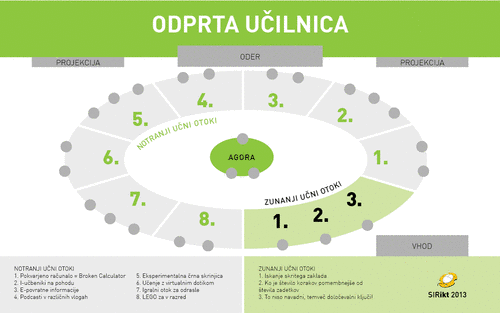
SIRIKT 2013 Open Space activities
Indoor Learning Island 1
Broken Calculator
(Learning mathematics with electronic calculators in various primary school grades; an interdisciplinary approach)
Darja Antolin, Mateja Sirnik, Andreja Verbinc, Katja Kmetec, Mateja Puizdar
The Broken Calculator is a set of activities for the second, sixth and ninth grades of primary school. Using electronic calculators, the participants will develop their perception of numbers and explore the structures of numeral systems and arithmetic operations. They will learn about mathematical concepts, evaluate the learning process, and compare it to the traditional pen-and-paper learning. In the last part the participants will also tackle equations, expressions and computational laws, while communicating in a foreign language. The games aim to encourage the participants to approach and solve problems using electronic calculators.
Indoor Learning Island 2
I-Textbooks on the Move
(Learning chemistry, physics, mathematics using tablet-based i-textbooks)
Simona Pustavrh, Robert Repnik, Boris Zmazek
A range of activities related to i-textbooks will be presented – from independent learning (at home and in school) to teachers using parts of units to achieve their teaching goals. We will show how i-textbooks can be used in the classroom and encourage critical assessment of their effectiveness. We will promote a methodically and didactically sensible use of active pictures to achieve a better understanding of content through visualization of new concepts. In addition, a method will be proposed that includes combined learning and teaching with an emphasis on the perception of interactivity and the level of reflexive learning.
Indoor Learning Island 3
E-Feedback
(Teaching Slovenian using the i-board and various response system devices)
John Collick, Maja Kosta, Mojca Osvald, Marijana Klemenčič Glavica
Practicing orthography while using most of your senses and, at the same time, taking a quiz to evaluate the knowledge of your mother tongue – is such a thing even possible? Google maps, Slovenian language corpora, the e-version of the Slovenian Orthography, and the Socrative response system will be used to show how to acquire and improve feedback. We will create a quiz, access it, use tablets to answer the questions, and, finally, reflect on our activities using statistical information about our answers.
Indoor Learning Island 4
Podcasts in Different Roles
(Using podcasts in language learning and teaching)
Simona Cajhen, Neva Šečerov, Alenka Andrin
This island will explore the use of podcasts in two stages of the learning/teaching process: in the stage of reception and in the stage of using the acquired knowledge. Podcasts will simultaneously assume the roles of source texts (sources of information) and final products (used for self-assessment based on learning goals). In addition, we will explore the example of using talkgroups to develop speaking based on spoken or written stimuli. We will also attempt to devise such stimuli on our own.
Indoor Learning Island 5
Experimental Black Box
(Biology, physics, chemistry, the LabQuest interface and various meters)
Darko Briški
Would you like to know what goes on in a black box and what is hidden inside it? We will use the LabQuest interface and various meters (for example, oxygen meter, carbon dioxide meter, pH meter, pressure meter and so on) to acquire different measurements. A box, not necessarily a black one, will hide a science experiment that has never been conducted before. Also, a model of experiential learning will be presented. And, for a change, an example of bad practice will be demonstrated. ☺
Indoor Learning Island 6
Learning through Virtual Touch
(Using Kinect in education)
Saša Divjak, Matevž Pesek
Do you know what Kinect is? Would you like to know how it works? Do you know what a virtual human is? Are you interested in immersive learning? The answers to these questions will be presented and explored on the basis of interesting didactic examples, including a simulation of an ecosystem and presentations involving Python, 3D graphics and more.
Indoor Learning Island 7
LEGO in the Classroom
(Physics experiments (robotics) using LEGO Education materials)
Maja Gačnik, Matevž Malej, Alenka Malej, Peter Vrčkovnik
LEGO Edu materials (mechanical and electrical machines and Mindstorms NXT) will be used to conduct physics experiments. We will explore the relevant classroom materials and independently engage in a range of activities using LEGO Educational materials.
Indoor Learning Island 8
Playground Island for Grown-ups
(Didactic computer games – from creation to application)
Jože Rugelj, Matej Zapušek
Playing games is usually an activity we attribute to children, but since adults also enjoy games, our playground island offers everyone an opportunity to play with and learn about various types of didactic games. We will also try to create new games on our own – there is a range of possibilities to do that. For example, we can arrange some animated scenes into a sequence and add a short text to the sequence. On the other hand, some more advanced options allow us to create 'real' didactic games – by using suitable tools, we can achieve such a goal in an hour or two.
Outdoor Learning Island 1
Treasure Hunt
(Teaching geography using GPS devices)
Tatjana Kikec, Mojca Janžekovič, Mirsad Skorupan
The treasure hunt will be entertaining and educational. We will learn how to use GPS devices, how to capture points, and how to create paths. The acquired data will be imported in Google Earth to find out more about the observed path. If the path includes different altitudes, we will also explore it through the elevation profile. What about the hidden treasure? Let that be a secret known only to the visitors of this outdoor island.
Outdoor Learning Island 2
When the Number of Steps Matters More than the Number of Hits
(Teaching physical education using QR codes and pedometers)
Nives Markun Puhan, Janja Polenšek Davidovski, Robert Pavli
Do you own a smartphone but do not use it for sports yet? It is high time you changed this. Join us, bring your smartphone and we will introduce you to a free pedometer app. We will explore how QR codes and other pedometers can be used in PE classes and sports activities. A range of basic games will follow a methodological approach that progresses from easy to difficult tasks. This transition will be demonstrated through changing the rules of the games. In addition, the activities will be straightforward enough to be immediately applicable in the classroom.
Outdoor Learning Island 3
These Are No Ordinary Keys – They Are Identification Keys
(Teaching science and biology using identification keys on mobile devices)
Kristina Prosen, Saša Kregar
Would you like to engage in experiential learning in the outdoors supported with mobile technology? Join us outside to learn about interactive identification keys and use them to identify plants and animals. With the help of mobile technology (tablets and smartphones), we will demonstrate models (examples) of experiential learning about nature in the natural environment. We will attempt to identify the 'intruder’ – an entity that, based on the characteristics we will observe, does not belong to the group of plants.
Central Gathering Space - Agora
In the centre of the Open Space, the Agora, we will reflect on the events, examine our thoughts, and focus our attention on volunteerism and charity. A group of students from the Trbovlje Grammar and Economics Secondary School, adorned with donated scarves, will – in return for a small voluntary contribution – offer the scarves to the participants of the Open Space and spread their message of charity. The students are confident that there is more than enough room in our hearts and more than enough time in our lives for new acts of volunteerism. The idea of volunteerism is also strongly related to the philosophy of the Open Space. It promotes the removal of obstacles among people, encourages new connections in a culture of coexistence and supports community change. The enthusiasm and the example of the students from Trbovlje will also encourage us to foster relationships with other institutions and join our forces to support volunteerism that benefits us all.